
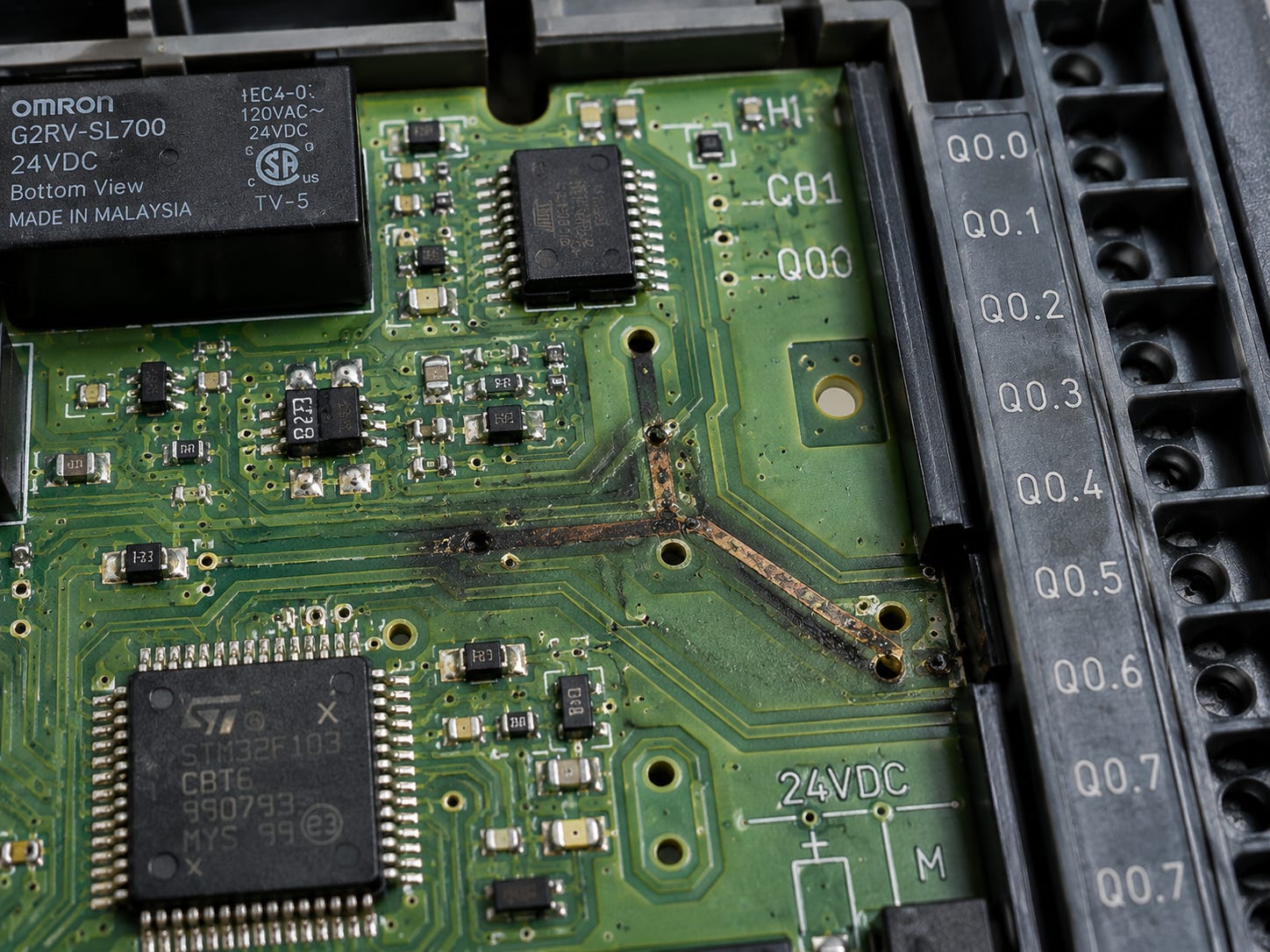
I fried a Programmable Logic Control (PLC) board once.
Not a cheap, abstract, “oops, rounding error” kind of mistake. A real one. I was moving wires around on a live system, didn’t pause to think about where 24 volts was going to land, and put it somewhere it didn’t belong. A channel went dead. The board was done.
Nobody got hurt. The board wasn’t too expensive. But we needed a replacement to keep the project moving, and there was a dead channel sitting there that was very obviously my fault.
Here’s what I did, in order. I called our supply chain guy, told him exactly what happened — not a sanitized version, the real one — and asked how fast he could get me a new board. Then, on the engineering weekly call, I told the whole team: here’s what I did, here’s why it happened, here’s the lesson. Pause before you move live wires. Build a “do nothing” moment into your process so the next person doesn’t fry a channel the way I just did.
Then I moved on.
I’m telling you this because it’s the cleanest example I have of the one rule in my entire book that is not flexible, not contextual, and not up for debate.
You cannot blame the tool.
Not the wire strippers. Not the meter. Not the schematic somebody else drew. And — the reason we’re here — not the AI.
Before I teach anyone a single AI workflow, a single framework, a single trick for doing engineering work faster, we establish this. It’s the foundation everything else sits on. You own everything that leaves your desk. Everything. If you used AI to generate it, you used a tool. The tool didn’t sign the drawing. The tool didn’t submit the report. The tool didn’t stamp the calculation.
You did. Your name. Your bond. Your word.
On the teams I’ve run, the rule is blunt: the first person to blame AI gets made an example of. The next person is fired.
That sounds harsh until you sit with what blaming the AI actually means. It means you’re telling me — and the client, and the contractor, and the code official — that you sent out work you didn’t verify. That you put your name on something you didn’t understand. That you were the quality control layer and you weren’t paying attention. You’ve abdicated your roll as the responsible party you were supposed to be.
In any other context, that’s grounds for termination. AI doesn’t change that. If anything it raises the stakes, because AI produces work at a volume you’ve never had to police before. More output means more chances for an uncaught error to slip past you and out the door with your name on it.
Here’s the way to make it simple in your head.
Imagine a first-year engineer on your team. Smart, fast, eager. Read every textbook. Cranks out calculations and reports at a pace that genuinely impresses you. But they’ve never set foot on a jobsite. They occasionally swap their air-side and water-side numbers. And every so often they’ll hand you a result, completely confident, that is just flat wrong — not because they’re bad, but because they’re inexperienced and running on pattern recognition instead of real understanding.
That’s AI. That is exactly what AI is.
Now: if that first-year engineer produced a calc that went out under your seal, and the system failed — who do you blame? The kid? Or yourself, for not checking it?
You blame yourself. Every licensed engineer already knows this in their bones. The seal doesn’t mean you personally ran every number. It means you reviewed the work, you understood it, and you stand behind it. That’s what the stamp is.
AI gets the same standard. Not a lower one because it’s fancy. Not a higher one because it’s new. The same one. You are the reviewer. You are quality control. You are the throat to choke when something goes wrong.
That’s the job. AI doesn’t change the job. It changes the speed at which the job happens.
You’re going to hear that AI is coming for engineers. You’ll hear it from tech guys who’ve never read a one-line diagram. You’ll hear it from nervous classmates. You might hear it from engineers who are scared of the change and looking for company.
It’s wrong, and the medical comparison is the fastest way to see why.
Nobody serious is arguing that AI should replace doctors. AI is transforming medicine — sharper imaging analysis, faster differential diagnosis, literature review at a scale no human can match. But the doctor still makes the call. The doctor still sees the patient. The doctor still owns the outcome. AI is amplifying the doctor’s judgment. It is not replacing it.
Engineering is the same deal. AI will let you deliver engineering judgment at a speed and scale previous generations couldn’t have dreamed of. It will not deliver the judgment for you. The buildings still have to stand. The systems still have to work. The physics still does not care about your prompt.
You’re not being replaced. You’re being amplified. But amplification needs something worth amplifying — and that something is the judgment you build, the verification habit you run, the willingness to put your name down and mean it.
So back to the fried board, because that little template is the whole ethic compressed into one move, and it works for everything: fried PLC boards, missed calcs, AI output you didn’t catch in time.
Own what happened. Explain the reasoning behind the call you made with the information you had. Don’t blame anyone — not a person, not a tool, not the circumstances. State the fix. State the process improvement. Execute. Then move on.
Living in the whodunit feels productive. It isn’t. Your team doesn’t want to watch you grovel and they sure as hell don’t want to watch you point at the AI. They want to see you own it, fix it, and get back to work. That’s what earns trust. And — I mean this literally — you can build credibility by failing properly. The engineer who breaks something, owns it instantly, shares the lesson, and adds a verification step is an engineer people fight to keep. The one who hides it or deflects is a liability no matter how brilliant they are.
A project manager in France told me something on my first wind tunnel commissioning that I’ve carried for over a decade:
“If engineering school is supposed to teach you anything, it’s that you know nothing — but it teaches you how to verify.”
That’s the deal. You know nothing, not with certainty, not without checking. But you know how to verify. In an age where the volume of work you can produce has exploded, that’s not a nice-to-have. It’s the whole job.
Own it. Verify it. Put your name on it.
That’s Rule Number One.
This is an adaptation of Chapter 1 of my forthcoming book, The AI-Era Engineer: A Field Guide for the Next Generation — a field guide for the people entering the profession during the biggest shift since CAD replaced the drafting board. I’m writing it because nobody gave me the mentor talk on this, and somebody should. More at theaieraengineer.com. If this landed, stick around — I’m unpacking one idea like this every week.
— Kyle Benesh, PE